
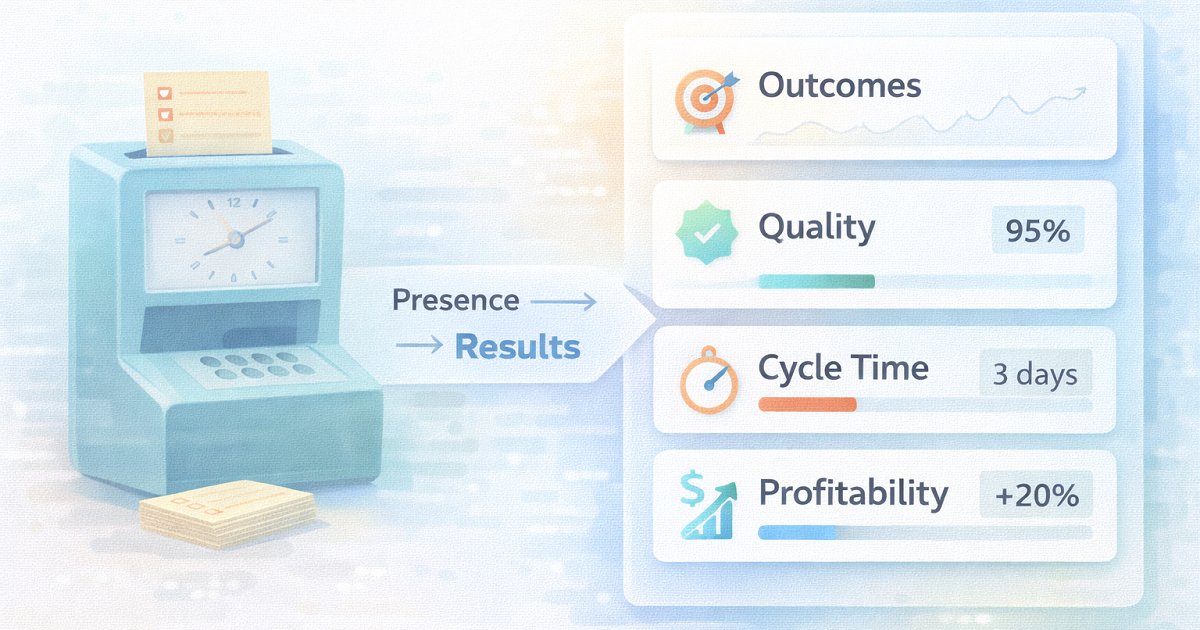
For decades, “productivity” at work was measured with one blunt proxy: presence.
Who’s at their desk?
Who’s online?
Who looks busy?
That model worked (sort of) in a factory-era mindset where output was visible and repeatable. But modern knowledge work doesn’t behave like that. Today, the most valuable work is often invisible: thinking, prioritizing, designing, problem-solving, writing, negotiating, debugging, planning.
And now the cracks are obvious—especially in remote/hybrid work—because being “present” can happen while getting nothing meaningful done.
Microsoft’s Work Trend Index research has highlighted how knowledge workers spend a huge share of time in communication and are interrupted constantly—signals that “time spent” isn’t the same as “value produced.”
So companies are finally moving from butts-in-seats to results.
This post explains why traditional productivity metrics are dying, what replaces them, and how to measure outcomes without turning your team into surveillance targets.
Why traditional productivity metrics are collapsing
1) Presence doesn’t equal progress
The easiest metrics to capture—hours worked, online status, keyboard/mouse activity—are often the least meaningful. They measure motion, not outcomes.
In modern work, a single high-quality decision can be worth more than a day of “activity.” Presence-based metrics miss that completely.
2) Work has become fragmented and interruption-heavy
When your day is split across meetings, email, and chat, “hours online” becomes a misleading signal.
Microsoft’s Work Trend Index research has reported that the average employee spends a majority of time communicating rather than creating, and that heavy meeting/email users spend many hours weekly in those channels.
If you reward being busy in communication tools, you often get… more communication tools usage.
3) Remote/hybrid made visibility unreliable
In an office, managers used physical visibility as a proxy. Remote work removed that crutch.
Some organizations responded with monitoring software. But that tends to create:
anxiety and mistrust
“performance theater” (looking busy)
worse collaboration
fewer creative risks
You can’t build high performance on fear.
4) The best teams optimize systems, not people
High-performing orgs increasingly measure system performance:
how fast work moves from idea → done
how often it ships successfully
how quickly it recovers from issues
how predictable delivery is
That’s why frameworks like DORA (software delivery performance metrics) became popular: they focus on delivery outcomes, not individual busyness.
What replaces “butts-in-seats”: outcome-based measurement
The modern replacement isn’t “one new metric.” It’s a balanced set that connects effort to results.
A helpful way to think about it:
Inputs → Process → Outputs → Outcomes
Inputs: time, budget, people
Process: how work flows (handoffs, reviews, meetings, rework)
Outputs: what shipped/delivered
Outcomes: the impact (revenue, retention, customer success, reliability)
Traditional metrics obsess over inputs. Modern measurement focuses on outputs + outcomes, with just enough input data to manage capacity and profitability.
The 6 productivity metrics that actually matter (and don’t require surveillance)
You don’t need all of these. Pick a few that match your business.
1) Delivery throughput (outputs)
tasks completed
milestones shipped
stories closed (with quality gates)
What it fixes: “busy but nothing finishes.”
2) Cycle time (speed of flow)
How long work takes from “started” to “done.”
This is a system metric: it reveals bottlenecks (reviews, approvals, unclear scope).
3) Quality + reliability
For software teams, DORA-style stability metrics (change failure rate, recovery time, etc.) are a strong counterbalance to “ship faster at any cost.”
4) Customer outcomes
customer satisfaction
churn/renewal
NPS (if you use it carefully)
ticket resolution satisfaction
This is where “results” becomes real.
5) Profitability (the most ignored metric)
For freelancers/agencies/service teams: project profitability is often the truth serum.
If your margins shrink, you’re not “productive”—you’re subsidizing work.
6) Team health (burnout and sustainability)
If your system requires constant overtime, the performance isn’t sustainable.
The SPACE framework (developed by researchers from Microsoft/GitHub/academia) explicitly includes satisfaction and well-being as a core dimension of productivity, alongside performance, activity, communication/collaboration, and efficiency/flow.
That’s a big shift: wellbeing is no longer “nice to have.” It’s part of the productivity model.
The metrics you should stop using (or demote heavily)
These aren’t always evil—but they’re dangerous as primary performance metrics:
hours logged (as a “value” metric)
time online / green-dot status
keystrokes, mouse movement
messages sent / emails sent
meetings attended
lines of code, tickets closed (without quality/outcome context)
These metrics are easy to game and often punish the behaviors you actually want: deep work, learning, better planning, better design.
A practical “Balanced Productivity Scorecard” you can use in Asrify
Here’s a clean setup that works for most teams without surveillance:
Outcomes (1–2 metrics)
revenue or profit per project/client
customer satisfaction / retention signal
Outputs (1–2 metrics)
milestones shipped
tasks completed with QA acceptance
Flow (1–2 metrics)
cycle time (start → done)
work-in-progress (how much is open at once)
Health (1 metric)
overtime hours (or “after-hours work” trend)
Time data (used correctly)
Time tracking shouldn’t be used to micromanage humans. Use it to:
protect profitability (billable vs non-billable)
detect scope creep early
understand where the system wastes time (meetings, rework)
price and estimate more accurately
That’s exactly where Asrify fits: time data as operational intelligence, not surveillance.
The “results” shift doesn’t mean time tracking is dead
This is the nuance most people miss:
Traditional productivity metrics die when they treat time as the goal.
Time tracking becomes powerful when it’s used to improve outcomes:
profitability
delivery predictability
scope clarity
capacity planning
reducing rework and meeting load
Modern teams track time the way finance tracks money:
not to shame spending—but to make better decisions.
How to implement results-based metrics without breaking trust
1) Make metrics team-level by default
Individual metrics encourage gaming. System metrics improve systems.
2) Separate “performance management” from “process improvement”
Use productivity metrics primarily to improve workflows, not punish people.
3) Publish the purpose
Tell your team: “We’re measuring to reduce waste and protect focus, not to monitor you.”
4) Always pair speed with quality
If you track throughput, also track quality. If you track shipping, track reliability.
5) Review trends, not snapshots
A single bad week is noise. Trends show real issues.
Bottom Line
“Butts-in-seats” metrics are dying because modern work is too complex, too interrupted, and too outcome-driven for presence to mean anything.
The replacement isn’t surveillance—it’s balanced, outcome-first measurement:
outcomes (impact)
outputs (what shipped)
flow (how smoothly work moves)
health (sustainability)
Frameworks like SPACE explicitly reinforce that productivity is multi-dimensional—not just activity.
And system-level delivery metrics (like DORA) show how outcome-focused measurement works in practice.
If you want results, measure results—and use time tracking (with Asrify) to improve the system that produces them.


