For most companies, the 4-day work week used to sound like a perk you announce, not a system you run.
But over the last few years, large trials have shown something important: a shorter week can work without crushing output—as long as teams redesign how work happens. In the UK’s major trial (61 companies, ~2,900 workers), most organizations kept the model after the pilot, and employees reported large wellbeing improvements (including big reductions in burnout).
Now add the 2026 factor: AI-driven productivity gains.
AI is not the reason a 4-day week works—but it’s becoming the easiest way to fund it, because it compresses the time spent on low-leverage work (drafts, follow-ups, repetitive writing, support responses, summaries). In controlled studies, generative AI has been shown to meaningfully reduce time on writing tasks while improving quality, and to increase throughput in customer support workflows.
The result is a new reality:
The 4-day week is shifting from “culture experiment” to “operational advantage.”
This guide explains what the evidence says, where AI helps (and where it doesn’t), and how to pilot a 4-day work week using time data—so you don’t gamble with revenue or delivery.
What we mean by a “4-day work week”
Most successful programs follow a simple concept often described as 100–80–100:
100% pay
80% time
100% output
That doesn’t mean “work 10-hour days.” It means redesigning work so the same outcomes happen with fewer hours—using process improvements, better focus, fewer meetings, and tighter prioritization. The UK pilot results and summaries from organizers consistently emphasize redesigning work rather than simply squeezing it into longer days.
The evidence: does a 4-day week actually work?
Results from major trials
Across widely reported trial outcomes, the pattern is consistent:
Business performance generally held steady or improved
Wellbeing improved significantly
Retention/attrition improved
Most participants kept the policy after the pilot
Examples from the UK trial reporting:
The majority of companies continued after the trial, and employees reported lower burnout and stress.
Follow-up reporting a year later found most companies retained the model, with many making it permanent.
More recent public-sector related reporting in Scotland also described stable service levels with improved wellbeing and productivity signals.
The takeaway: The 4-day week works best when it’s treated as a work redesign program, not just “Friday off.”
Why AI makes the 4-day week more realistic in 2026
A 4-day week needs a “funding source.” Not money—time.
AI is becoming that source because it reduces effort in the parts of work that are necessary but not high-value. Two research findings are especially relevant:
In a controlled experiment on professional writing tasks, ChatGPT reduced time by ~40% and increased quality by ~18%.
In a large field study in customer support, a generative AI assistant increased productivity by about 14% on average, with much larger gains for less experienced workers.
That doesn’t magically create a day off. But it does create a real opportunity:
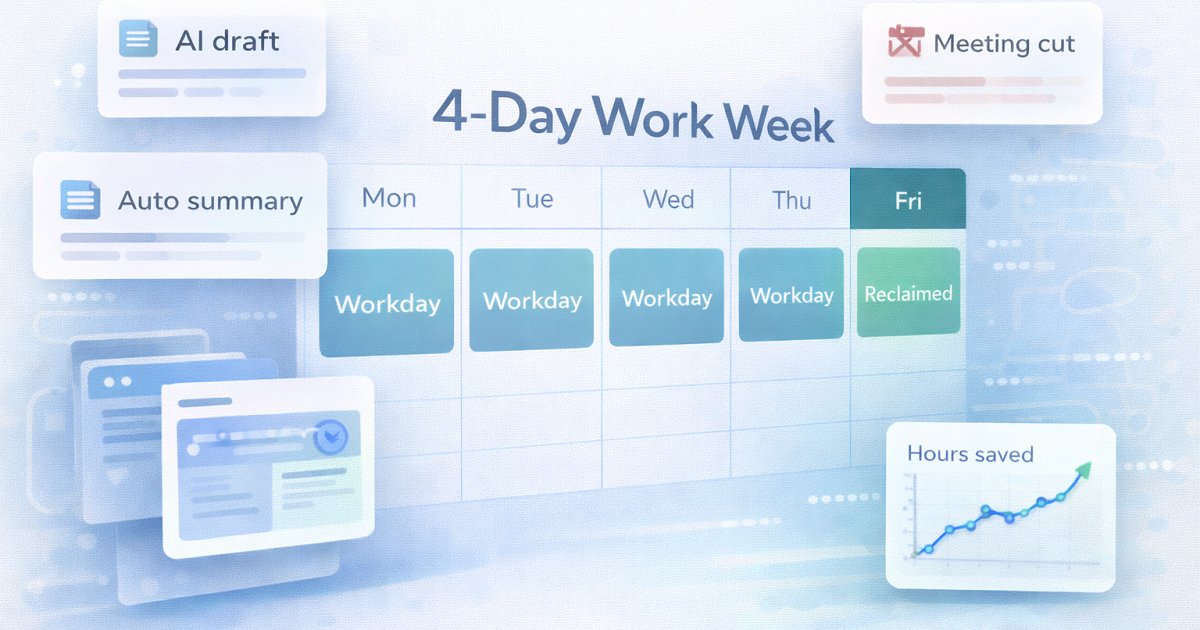
If you convert AI time savings into fewer meetings, faster cycles, and less rework, you can reclaim enough capacity to reduce the week without harming outcomes.
Where AI creates real savings (and where it doesn’t)
High-confidence time savers (most teams have these)
These are the areas where AI tends to compress work without requiring risky decisions:
First drafts: emails, proposals, project updates, documentation (you still edit and approve)
Summaries: long threads, meeting notes, research briefs
Customer support and internal help: suggested responses, knowledge-base retrieval, faster resolution (human oversight matters)
Planning scaffolds: agendas, checklists, rollout plans, risk lists
Repetitive rewriting: turning messy thoughts into clean output
The studies above strongly support time savings in writing-heavy and support-heavy workflows.
Lower-confidence time savers (use cautiously)
These areas can help, but they require stronger judgment and QA:
Strategy decisions (AI can structure thinking, but shouldn’t “decide”)
Complex technical implementation (AI accelerates, but errors can cost more than it saves)
Performance evaluation (high risk, easily erodes trust)
Rule of thumb: Use AI to remove busywork and speed up “prep work,” then keep humans responsible for correctness and decisions.
The real secret of the 4-day week: it’s not hours, it’s friction
Most organizations don’t lose Friday to “lack of effort.” They lose it to friction:
meetings that should have been async
unclear priorities
context switching
rework caused by vague requirements
slow approvals
status reporting that steals focus
AI helps most when it’s paired with operational rules that reduce friction.
So the goal is not “AI everywhere.”
The goal is AI + redesigned workflow.
The 4-Day Week Playbook that actually works (with Asrify)
Here’s a practical pilot plan you can run without guessing.
Step 1: Baseline your week (7 days)
Before you change anything, measure where time really goes.
Track time into a small set of categories:
Deep work (delivery)
Meetings
Admin
Support/interruptions
Rework/QA
Internal coordination
Asrify tip: Create these as tags or categories so reporting is automatic.
Your baseline answers one essential question:
“If we cut one day, what work would explode?”
That’s your redesign target.
Step 2: Pick the right 4-day model for your business
There are multiple “4-day week” implementations. Choose based on customer coverage needs:
Universal day off (everyone off Friday)
Best for product teams or internal-heavy work.Staggered coverage (some off Monday, some Friday)
Best for support, agencies, and customer-facing teams.Seasonal (4-day summer, 5-day winter)
Good for risk management.Meeting-free day + shorter week later
Great stepping stone if you’re not ready.
Trials and follow-up reports emphasize that implementation varies and that companies used different scheduling models to maintain coverage.
Step 3: Use AI to fund the change (the “time dividend”)
Create a short list of AI-supported shifts that directly reclaim hours:
Replace long status meetings with AI-assisted weekly written updates
Use AI to draft client updates, proposals, summaries (then you edit)
Use AI to produce meeting agendas + decisions + next steps so meetings are shorter
Use AI to draft documentation so fewer questions interrupt deep work
Use AI in support workflows for faster first responses (human-approved)
Important: Put the reclaimed time somewhere explicit—otherwise it gets refilled.
Step 4: Introduce the 4-day rules (this is the difference-maker)
Most successful pilots don’t rely on motivation; they rely on rules.
A strong starter set:
Meeting cap: max X hours/week per person
Async-first: default to written updates, meetings only for decisions
No-meeting blocks: protected deep work windows
Definition of done: reduce rework by clarifying quality expectations
Stop-work policy: work does not “spill” into the fifth day unless critical
This matches what many organizations report: success comes from restructuring work, improving planning, and reducing waste—not squeezing harder.
Step 5: Track the 4 metrics that matter (weekly)
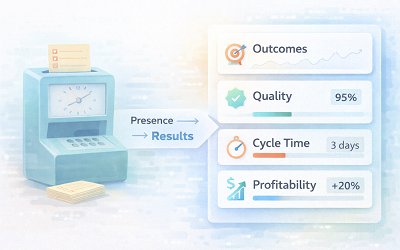
To make the pilot safe, track outcomes that prove it’s working:
Delivery output (tasks shipped, milestones, cycle time)
Business performance (revenue, pipeline, utilization if services)
Service level (support response time, customer satisfaction)
People health (burnout proxy, overtime hours, attrition/absence)
The UK trial reporting repeatedly highlights performance stability alongside reduced burnout and improvements in retention/absence.
Asrify tip: This is where time tracking becomes strategic. You’re not tracking “to watch people.” You’re tracking to verify that redesign is working and to spot where friction remains.
Step 6: Run a 6–8 week pilot (then decide)
A pilot is not a permanent policy. It’s a learning loop.
At the end, ask:
Did output remain stable?
Did overtime rise (hidden cost)?
Did meeting time drop?
Did rework drop?
Did we protect deep work?
What processes need improvement before making it permanent?
This “iterate based on data” approach matches how many organizations described refining their schedules and practices after trial periods.
What changes first when a 4-day week is working
You’ll typically see these leading indicators:
Fewer meetings (or shorter meetings)
Better written communication
Faster decision-making
More focus time
Less “busywork reporting”
More predictable delivery
If you don’t see these within 2–3 weeks, you’re not running a 4-day week—you’re running a 5-day workload inside 4 days.
Common failure modes (and how to avoid them)
1) “Same workload, fewer days”
Fix: Reduce work-in-progress, cut meetings, formalize priorities.
2) Overtime silently increases
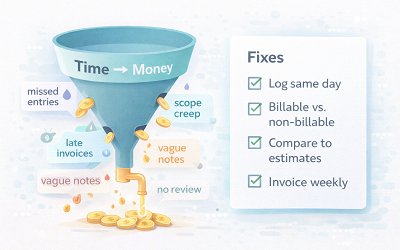
Fix: Track overtime explicitly. If overtime rises, the model isn’t funded yet.
3) Customer coverage breaks
Fix: Use staggered schedules and clear escalation rules.
4) Rework eats the reclaimed time
Fix: Better requirements, checklists, definition of done, QA gates.
5) AI increases speed but decreases trust
Fix: Make AI assistive, transparent, and optional where appropriate. Keep humans accountable for decisions and quality.
How Asrify helps you make a 4-day week sustainable
A 4-day week becomes real when you can see:
where time is going,
what’s shrinking,
what’s growing,
and what’s creating hidden overtime.
With Asrify, you can:
run a time audit baseline by category (delivery vs meetings vs admin vs rework)
track deep work protection (are focus blocks real or constantly broken?)
measure AI time dividend (time saved by faster drafts/updates/support)
monitor project profitability (especially for agencies/services)
prove whether the pilot is working with weekly reporting
That’s how the 4-day week moves from a vibe to an operational advantage.
Final thought: AI doesn’t “create” a 4-day week—discipline does
The trials show shorter weeks can work when work is redesigned and outcomes are protected.
AI makes that redesign easier by compressing low-value effort—especially in writing-heavy and support-heavy work—where research shows meaningful productivity gains.
If you want a 4-day week in 2026, the winning formula is:
Measure → Remove waste → Use AI to compress busywork → Protect deep work → Track outcomes → Iterate.
That’s the path from “cool idea” to “sustainable operating model.”