
The fastest way to fall behind in 2026 isn’t a lack of effort. It’s spending your best hours on work that doesn’t compound.
Top performers protect compounding time—learning, thinking, and experimentation—because it keeps them ahead even when their workload grows. One popular framework for this is the 5-Hour Rule: dedicate one hour a day (five hours per workweek) to deliberate learning and improvement. The idea is widely attributed to Michael Simmons (often framed as “Franklin’s five-hour rule,” inspired by Benjamin Franklin’s learning habits).
What changed in 2026 is how high performers create that hour.
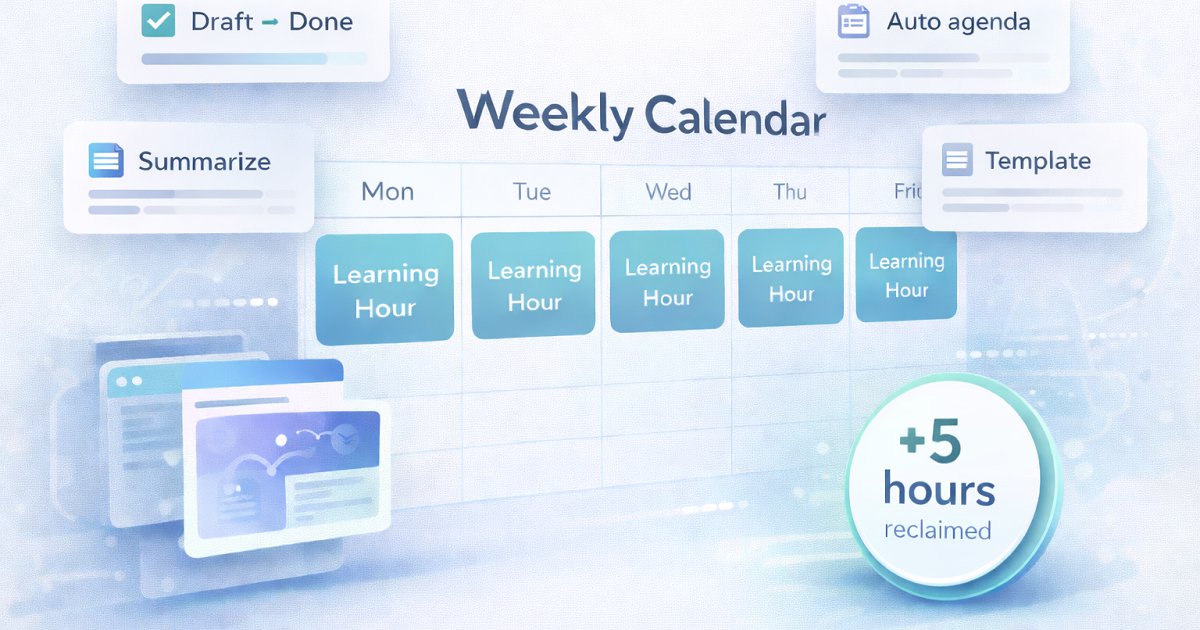
They don’t “find time.” They reclaim it—using AI to compress low-leverage work and convert that saved time into a consistent 5-hour weekly block.
This guide shows exactly how they do it, with a practical weekly system you can copy.
What the 5-Hour Rule really means (and why it works)
The 5-Hour Rule isn’t “read more.” It’s deliberate improvement:
learning something specific,
reflecting on it,
and turning it into better decisions, better systems, and better execution.
That’s why it compounds: you’re not just producing—you're improving the machine that produces.
It also aligns with a well-supported idea from performance research: expertise is not only a function of experience; it’s shaped by structured, intentional practice and feedback loops (often discussed under “deliberate practice”).
The 2026 twist: AI makes the 5-Hour Rule realistic again
Before AI, the 5-Hour Rule was hard because the week got eaten by:
writing and rewriting,
admin and follow-ups,
meeting prep and notes,
repetitive explanations,
context switching.
In 2026, AI is a leverage tool for reclaiming time—because there’s credible evidence that AI assistance can significantly reduce time spent on common knowledge-work tasks.
Two research results are especially relevant:
In a controlled experiment on professional writing tasks, access to ChatGPT reduced task completion time by ~40% and increased output quality by ~18%.
In a large field study in customer support, a generative AI assistant increased productivity by about 14% on average (with much larger gains for less-experienced workers).
You don’t need to be a researcher to feel that impact. If your week includes writing, planning, summarizing, responding, or organizing, AI can compress the “first draft” and “first pass” of work—so you can spend your human attention on judgment.
That reclaimed time is how top performers fund their 5 hours.
The principle: Don’t use AI to do more. Use AI to do less.
A lot of people use AI to increase output. Top performers use it to increase time quality.
They apply AI to:
reduce low-value effort,
remove bottlenecks,
and protect blocks of deep work and learning.
Then they reinvest the saved time into the 5-Hour Rule.
Think of it like this:
AI → Reclaimed minutes → Protected hour → Compounding advantage
Where top performers “reclaim” time with AI (the high-ROI list)
1) Writing compression (emails, proposals, docs, updates)
Instead of starting from blank:
generate a structured outline,
draft in your tone,
shorten and clarify,
produce variants (formal, short, persuasive).
This is exactly the category where research shows big time savings.
Best practice: You remain editor-in-chief. AI writes; you decide.
2) Meeting elimination (not better meetings—fewer meetings)
Top performers use AI to:
pre-read and summarize threads/docs,
write agendas that cut scope,
generate crisp decisions + next steps,
produce follow-ups instantly.
The goal isn’t “AI meeting notes.” The goal is: meet less because alignment is cheaper.
3) Decision clarity (turn messy inputs into clear choices)
Use AI to:
compare options with pros/cons,
identify hidden assumptions,
propose an experiment plan,
suggest what to measure.
This converts overwhelm into action.
4) Operational templates (systems that prevent repeat work)
Top performers turn repeated tasks into reusable assets:
onboarding checklist
client update format
project kickoff questions
QA checklist
“definition of done”
AI helps draft these quickly; the team improves them over time.
5) Learning acceleration (faster comprehension + recall)
AI is a learning multiplier when used as:
a tutor (ask “explain like I’m busy”)
a quiz generator
a practice coach (role play, scenarios)
a summarizer of what matters for your work
This is the perfect bridge into your 5-Hour Rule block.
The 5-Hour Rule (2026 Edition): a weekly system you can actually keep
Here’s the structure top performers use:
Step 1: Choose one “learning theme” per week
Examples:
pricing & negotiation
product strategy
hiring & leadership
SEO & distribution
project profitability
sales calls & objection handling
One theme keeps your learning focused and usable.
Step 2: Protect one hour per day (Mon–Fri)
Your 5 hours should include three modes:
Learn (input)
Reflect (meaning)
Apply (output)
If you only learn, it doesn’t compound. If you apply, it does.
Step 3: Use AI inside the hour (not outside it)
Your hour is sacred. Don’t waste it searching, organizing, formatting.
Use AI to:
summarize sources into the key points relevant to your theme,
test your understanding,
generate a small experiment you can run this week,
draft a template/checklist you’ll reuse.
A simple 5-day playbook (copy/paste into your calendar)
Monday — Learn (60 min)
Pick 1 high-quality source (article, paper, book chapter, talk).
Ask AI to summarize it into: “what matters,” “how to apply,” “what to test.”
Tuesday — Skill (60 min)
Practice: role-play negotiation, sales objections, or performance review.
Ask AI to challenge you and score your answer.
Wednesday — System (60 min)
Turn your learning into a template/checklist you can reuse.
Example: “Client onboarding checklist,” “Scope creep prevention script.”
Thursday — Experiment (60 min)
Design a small real-world test for this week.
Example: change your proposal structure; add a boundary; reduce a meeting.
Friday — Review (60 min)
Reflect: what changed? what worked? what will you keep?
Write 5 bullet lessons and one rule you’ll carry forward.
This is how the 5 hours become compounding.
How Asrify fits: measure reclaimed time so it becomes permanent
Reclaimed time disappears unless you track it.
Top performers treat time like money:
they audit where it goes,
they identify leaks,
they reinvest into higher-return activities.
With Asrify, you can operationalize this:
1) Create two tracking buckets
AI-assisted (reclaimed time)
5-Hour Rule (learning + improvement)
2) Run a 2-week “time reclaim audit”
Track:
time spent writing, admin, meetings, follow-ups
where AI reduced the workload
how much of that saved time actually became protected learning time
3) Set a weekly minimum
Example:
5 hours “Learning/Improvement”
2 hours “Systems/Templates”
reduce “Admin” by 20%
When you can see the shift, you keep it.
The real goal: from busy to better
The 5-Hour Rule isn’t self-help. It’s a competitive strategy.
In 2026, AI gives you a realistic way to reclaim time—because it can compress common tasks and reduce effort while maintaining or improving quality in certain workflows.
But the advantage doesn’t come from AI alone.
It comes from what you do with the time you get back.
Use AI to reclaim your week. Then invest five hours into becoming harder to replace.


