
If the 4-day work week were just a “nice idea,” most companies would test it, enjoy the PR, and quietly revert to normal.
That’s not what happened in the world’s largest modern pilot.
In the UK’s six-month 4-day week trial (61 companies, ~2,900 employees), 56 of 61 companies (92%) chose to continue after the pilot ended, and 18 confirmed it as a permanent change right away.
So why did such a high percentage keep it?
Because the 4-day week isn’t really about “working less.” It’s about running work differently—and the trial forced companies to remove waste they had tolerated for years.
This article breaks down the real reasons the 4-day week sticks, what the data actually says, and how to evaluate it responsibly (especially for agencies and service businesses where utilization matters).
First, what does “92% keep it” actually mean?
The “92%” number comes from post-trial plans in the UK pilot: 56 of 61 participating organizations said they were continuing with a 4-day week after the trial period.
Even more interesting: follow-up reporting a year later found 54 of 61 (89%) were still using the policy, and a larger share had made it permanent (different measurement, later point in time).
So the headline is accurate for the pilot outcome—and the longer-term signal still supports the same conclusion: once organizations redesign work successfully, they rarely want to go back.
The real reason companies keep the 4-day week: it removes “work pollution”
Most workweeks are full of time sinks that feel normal because “that’s how work is”:
meetings without decisions
status updates that could be async
unclear priorities that create rework
long handoffs and slow approvals
context switching (tiny tasks that kill deep work)
invisible overtime that becomes the default
The 4-day week forces a question most companies avoid:
“If we had one less day, what would we stop doing?”
That’s why the policy sticks. Companies discover that a huge chunk of time was never truly necessary.
7 reasons the 4-day week is hard to undo once it works
1) Wellbeing improvements show up fast (and people won’t give them back)
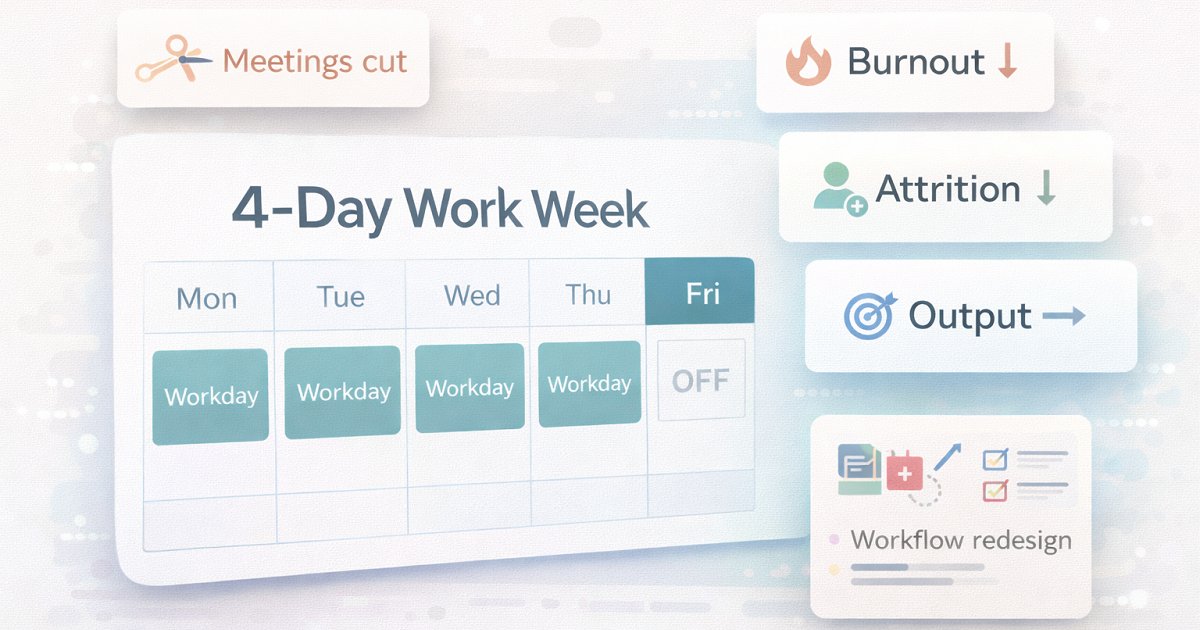
In the UK pilot, “before and after” data showed major wellbeing gains—like reduced burnout (71%) and lower stress (39%) by the end of the trial.
Once teams experience:
more recovery time,
fewer “Sunday scaries,”
and less burnout,
…going back to five days feels like a pay cut in quality of life.
2) Retention and absence improve (and that’s real money)
One of the clearest business reasons to keep a shorter week: it helps keep people and reduces disruption.
Reported results from the UK pilot include a large reduction in staff leaving (57%) and a reduction in absenteeism (65%) in widely cited summaries of the trial.
Even if your output stayed the same, fewer resignations and fewer sick days can easily justify the change.
3) Recruitment becomes easier (and that’s a competitive advantage)
A 4-day week is one of the strongest “why us” differentiators you can offer—especially when it’s true reduced time, not compressed 10-hour days.
In follow-up reporting on the UK trial, participating companies cited improved recruitment and retention as key benefits.
In tight labor markets, that matters.
4) It forces better management: fewer meetings, sharper priorities, faster decisions
This is the part most people miss:
A 4-day week is a management upgrade disguised as a perk.
Companies that kept it didn’t magically become “more productive.” They got stricter about:
meeting hygiene
decision ownership
work-in-progress limits
clearer definitions of done
smaller batches and fewer handoffs
When the redesign works, teams realize their old schedule was funding inefficiency.
5) Many companies don’t lose output—because they weren’t using all 5 days well anyway
Across trial reporting, a consistent theme is that business performance generally held steady while wellbeing improved.
That sounds counterintuitive until you remember:
fewer meetings can unlock hours of deep work,
fewer context switches increase throughput,
less burnout improves quality and speed.
6) “Pilot first” reduces risk and filters out bad fits
A hidden reason the keep-rate is high: this wasn’t random adoption. It was a structured trial with organizations willing to experiment and redesign work.
That means:
companies learned what schedule model fits (shared day off vs staggered coverage),
they adjusted policies,
and they didn’t rely on vibes—they relied on measurement and iteration.
7) AI and automation are quietly funding the shift
The 4-day week doesn’t succeed by “trying harder.” It succeeds by removing low-value work.
In 2026, AI makes that easier by compressing:
drafting and rewriting,
summarizing,
recurring admin,
support responses,
meeting preparation and follow-ups.
That doesn’t guarantee a 4-day week—but it makes the redesign easier to sustain, especially in writing-heavy teams. (And this is one reason the idea keeps spreading across countries and pilots.)
The honest truth: not every industry can do it the same way
A 4-day week is easier in work that is:
output-based,
flexible in scheduling,
and less dependent on real-time coverage.
It’s harder in:
continuous operations,
high-volume frontline service,
and roles where “coverage hours” are the product.
Even supporters acknowledge sector limitations and implementation challenges.
That doesn’t mean it’s impossible—it means the model often needs staggered schedules or carefully designed coverage rules.
What makes a 4-day week fail (and why the successful companies avoided it)
The most common failure pattern is simple:
Trying to cram a 5-day workload into 4 days.
That creates:
hidden overtime,
exhaustion,
quality drops,
and resentment.
The companies that succeed treat it as a work redesign program—protecting the day off and changing how work flows.
What this means for service businesses (freelancers + agencies)
If you sell time (or deliver projects under fixed budgets), the 4-day week raises two real questions:
Will profitability drop?
Will client responsiveness suffer?
The pilots suggest performance can hold—but services teams must measure:
billable vs non-billable time,
utilization,
scope creep,
and overtime.
That’s where time tracking stops being “tracking” and becomes operational control.
How Asrify helps you evaluate a 4-day week without guessing
If you’re reading this as a founder, agency owner, or team lead, the smart approach isn’t “announce it.” It’s: measure it like a business experiment.
With Asrify, you can run a clean evaluation by tracking:
Deep work vs meetings (is meeting time actually dropping?)
Billable vs non-billable leakage (is the shorter week pushing more work into overhead?)
Overtime (the #1 silent killer of 4-day week success)
Project profitability (are margins holding steady?)
Delivery cadence (are you shipping faster because work is more focused?)
If the numbers stay healthy and overtime doesn’t climb, you’re not “reducing hours.” You’re removing waste—which is exactly why companies keep it.
Bottom line
Companies keep the 4-day week not because it’s trendy, but because it forces a better way of working—and the benefits are hard to unsee:
improved wellbeing (less burnout and stress)
stronger retention and fewer absences (in widely cited trial summaries)
competitive hiring advantage
and (when done right) stable performance
If you want to explore it seriously, treat it like an operations upgrade—measure the baseline, remove waste, track overtime, and use Asrify to prove whether the change is real and sustainable.


