
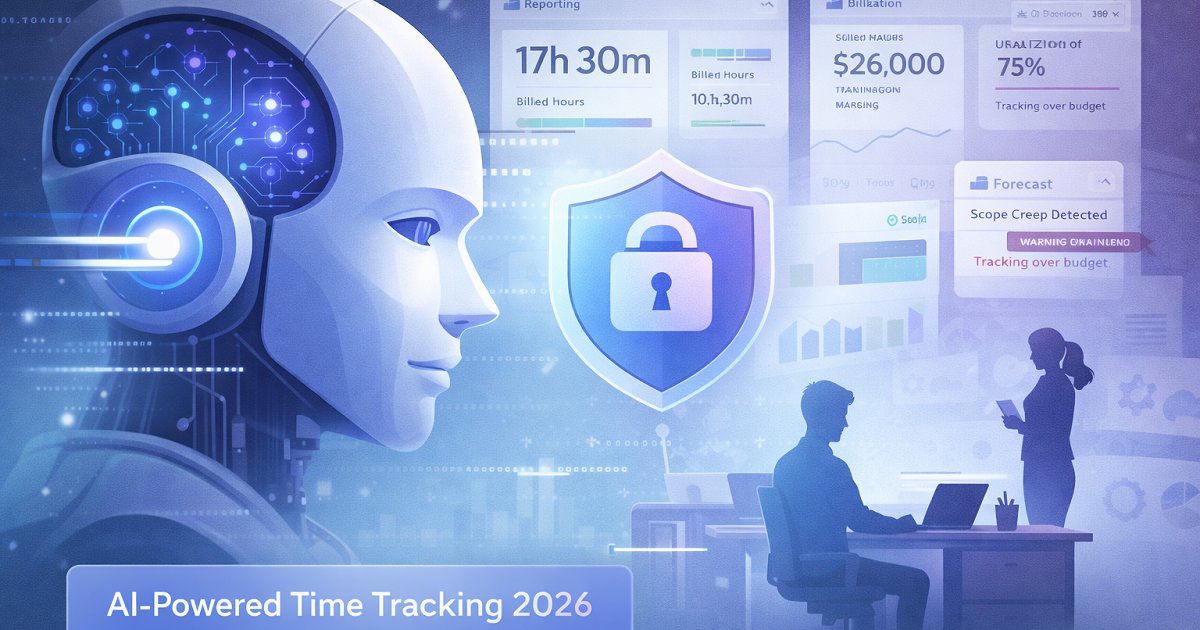
AI didn’t just make time tracking faster in 2026—it changed what “good” looks like.
For years, time tracking lived in two extremes:
Manual pain (timers you forget, messy timesheets, missing billable hours)
Surveillance pain (screenshots, keystrokes, “activity scores,” and trust issues)
In 2026, the market moved hard toward a third path: optimization.
Modern teams don’t want to “watch employees.” They want to:
capture work with less friction,
understand where time really goes,
improve estimates and project margins,
reduce non-billable leakage,
protect focus time—without creepy monitoring.
This article explains what changed, what buyers now expect, and how Asrify fits the new standard.
The 2026 shift: from “prove you worked” to “help us work better”
The biggest change is philosophical:
Old: Time tracking was evidence.
New: Time tracking is intelligence.
Teams are using time data less for policing and more for:
project profitability,
pricing accuracy,
capacity planning,
workload balance,
and decision-making (what to stop doing, what to automate, what to standardize).
That shift is why “AI time tracking” searches grew: people aren’t looking for a smarter timer—they’re looking for smarter outcomes.
What AI changed in time tracking (in practical terms)
1) Timesheets became “review and confirm,” not “start and stop”
The biggest win AI brought is reducing human memory work.
Instead of relying on perfect timer habits, 2026 time tracking leans on:
calendar context (meetings + titles),
task context (what you were assigned),
lightweight suggestions (“this looks like Client A work”),
and quick approval workflows.
The goal: fewer missing hours and less end-of-week panic.
Asrify angle: Asrify’s advantage is when time is connected to real work context (projects, tasks, notes). When time entries aren’t floating in a vacuum, people actually trust and use the data.
2) AI made billable vs non-billable tracking finally usable
Most teams lose profit in the gray zone:
“quick calls”
“small changes”
Slack/email back-and-forth
internal coordination that wasn’t planned
AI-driven categorization and smarter defaults made it easier to see:
what’s billable,
what’s overhead,
and what’s leaking.
Asrify angle: This is where Asrify can win: clear billable vs non-billable classification plus reporting that shows where time is leaking (admin, meetings, support, revisions). The outcome isn’t a prettier chart—it’s better pricing and better boundaries.
3) Time tracking started serving profitability (not just reporting)
In 2026, time tracking is tied directly to margins.
Teams expect answers like:
Which clients are profitable after communication overhead?
Which projects consistently go over budget?
Which tasks are always underestimated (QA, revisions, meetings)?
Are retainers priced correctly based on actual delivery time?
Asrify angle: This is exactly the “optimization” story: time tracking that feeds project profitability, budgets, and planning—not surveillance.
4) “Employee monitoring” became a brand risk
Buyers got more careful.
If your time tracking feels like surveillance, you’ll see:
adoption problems,
morale problems,
and reputational risk (“bossware” label).
In 2026, privacy-first design is a competitive advantage:
collect only what you need,
keep reporting focused on outcomes,
and avoid creepy signals that don’t improve delivery.
Asrify angle: Position Asrify as trust-first time tracking: teams track time to improve execution, not to spy.
What people search for in 2026 (and what they actually mean)
When people search:
“AI time tracking” → they want less manual work + better insights
“automatic timesheets” → they want accurate logs without timer stress
“billable hours AI” → they want to stop losing revenue to invisible work
“project profitability tracking” → they want margin clarity per client/project
“utilization without burnout” → they want balanced workload, not pressure
These are optimization queries—not surveillance queries.
The new expectations: what “good” time tracking looks like in 2026
A) Effortless capture
People want time tracking that fits into work instead of interrupting it.
B) Context-aware reporting
Time should attach to:
client,
project,
task,
and a short “what was produced” note.
C) Profit signals
Teams want to see:
margin trends,
budget burn,
and scope creep early.
D) Clear boundaries
Time tracking should support better contracts and pricing—especially around:
meetings,
support,
revisions,
and “quick requests.”
E) Privacy-first by default
No creepiness. No fake productivity scores. Just actionable operational insight.
How Asrify fits the 2026 AI time tracking story
Asrify isn’t “AI for the sake of AI.” The value is what teams get from time data:
1) Track time in context (not in isolation)
Time entries become useful when they’re tied to projects and tasks—so teams can see what work actually costs.
2) Separate billable vs non-billable (and expose leakage)
Asrify can help teams identify:
hidden non-billable work,
client overhead,
and workload imbalance.
3) Improve estimates with real history
Once teams consistently track time against projects/tasks, they can quote with confidence and stop repeating underpriced work.
4) Optimize workflow, not people
The best positioning line in 2026:
“Asrify helps you optimize projects and profitability—without surveillance.”
Real examples of optimization (what teams do after they see the data)
Once teams have clean time data, they make decisions like:
packaging services with clearer scope
adding meeting limits or support retainers
reducing internal meetings and protecting focus blocks
standardizing delivery checklists to reduce rework
shifting low-value admin work into templates and automation
This is the ROI. Not “tracking.” Decisions.


