
Real-World Scenarios
See how teams in your industry use Asrify to solve common challenges.
Managing Multiple Client Service Agreements
Your IT services firm manages 50+ clients with varying service level agreements. Tracking time for each client engagement is complex, and billing accuracy is critical.
Create a project in Asrify for each client. Technicians track time as they work on tickets and projects. Reports show hours by client for accurate billing against SLAs.
Clear visibility into time allocation across all clients. Billing is accurate and backed by detailed time records. You identify which clients are over or under their service agreements.
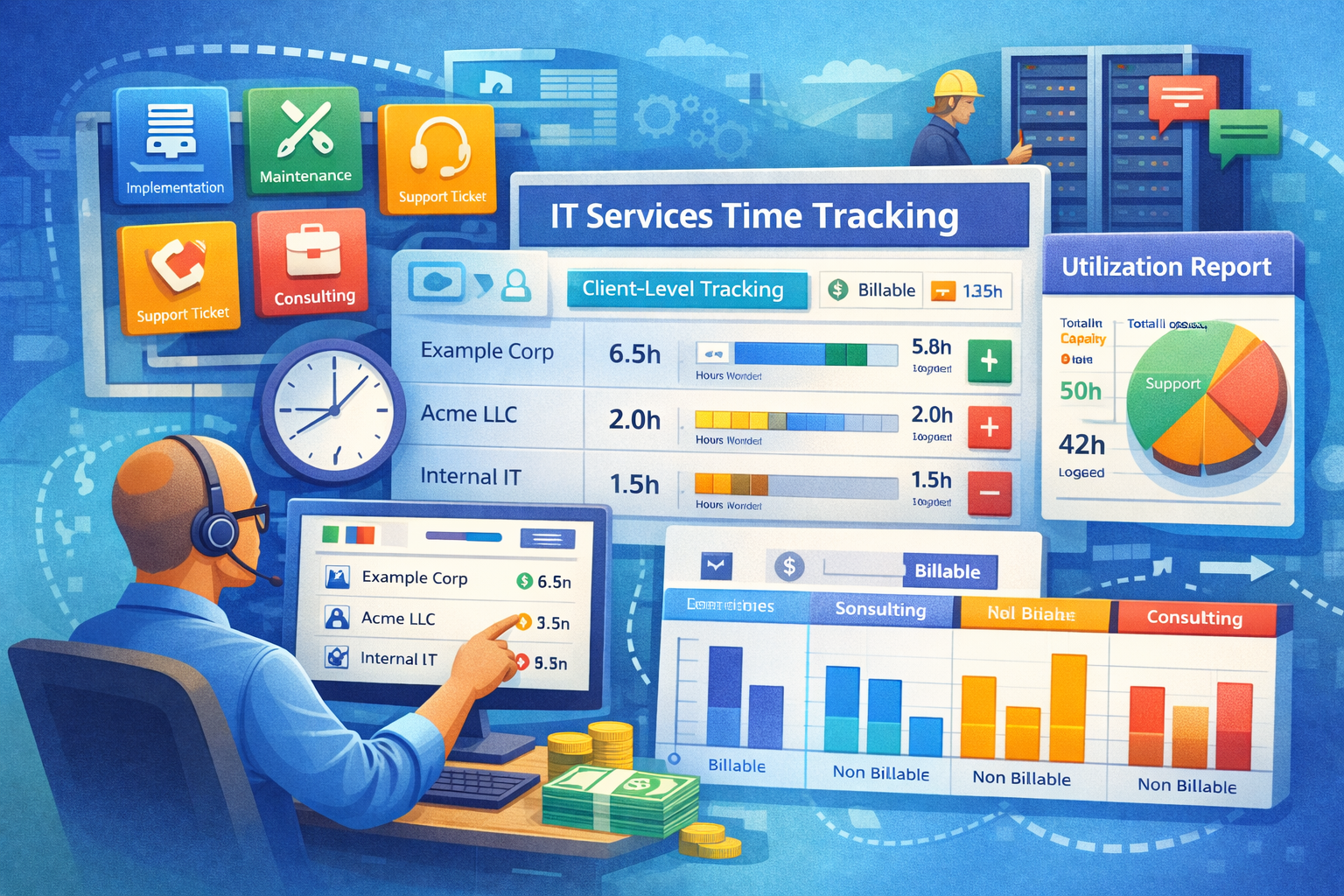
IT Services Time Tracking
Track time on implementations, maintenance, support tickets, and consulting.
- Client-Level Tracking - Log time to specific client accounts.
- Billable vs. Non-Billable - Separate client work from internal time.
- Utilization Reports - See team utilization and capacity.

Service Ticket Organization
Organize support requests and technical projects by client.
- Ticket Tracking - Track support requests from submission to resolution.
- SLA Monitoring - Monitor response times against SLAs.
- Team Assignments - Assign tickets to available technicians.
The Managed Services Business Model
IT service providers operate in a market where clients increasingly expect predictable costs and proactive support. The shift from break-fix to managed services has transformed the industry, creating recurring revenue opportunities but also raising expectations for service quality. Providers must balance the efficiency gains from standardization against the customization that enterprise clients demand.
Service level agreements define the relationship between IT providers and their clients, but they also create operational complexity. Different clients have different response time requirements, coverage hours, and escalation procedures. Tracking time and ticket resolution against SLA terms is essential for maintaining compliance and identifying at-risk accounts before they become complaints.
The economics of managed services depend heavily on achieving efficiency at scale. A provider supporting 50 similar clients can develop standardized procedures, automate common tasks, and build deep expertise that makes each additional client more profitable. But this requires discipline in client selection and the courage to walk away from prospects whose needs fall outside your service model.
Technology evolution creates both opportunity and pressure for IT service providers. Cloud migration projects generate significant project revenue, but they also reduce ongoing management fees as infrastructure moves from on-premises to hyperscaler platforms. Forward-thinking providers are building practices around cloud management, security, and compliance services that generate recurring revenue in the new environment.
Managing time across 60+ clients was chaotic. Asrify gave us clarity and improved our billing accuracy.