
Real-World Scenarios
See how teams in your industry use Asrify to solve common challenges.
Solo Consultant with Multiple Clients
You work with 5 clients simultaneously. Each expects regular updates and accurate billing. Tracking time across contexts is challenging.
Create a project in Asrify for each client. Start a timer when working on client work, stop when done. Switch between client timers as you switch contexts.
Monthly invoices show exact hours by engagement. You understand your true billable ratio and can make informed decisions about taking new clients.
Consulting Firm with Multiple Consultants
Your firm has 10 consultants working across 20 client engagements. Partners need visibility into utilization and project health.
Each consultant tracks time in Asrify. Partners see team-wide dashboards showing utilization, project hours, and billable ratios.
Better resource allocation, accurate client billing, and visibility into firm performance.
Precise Time Tracking
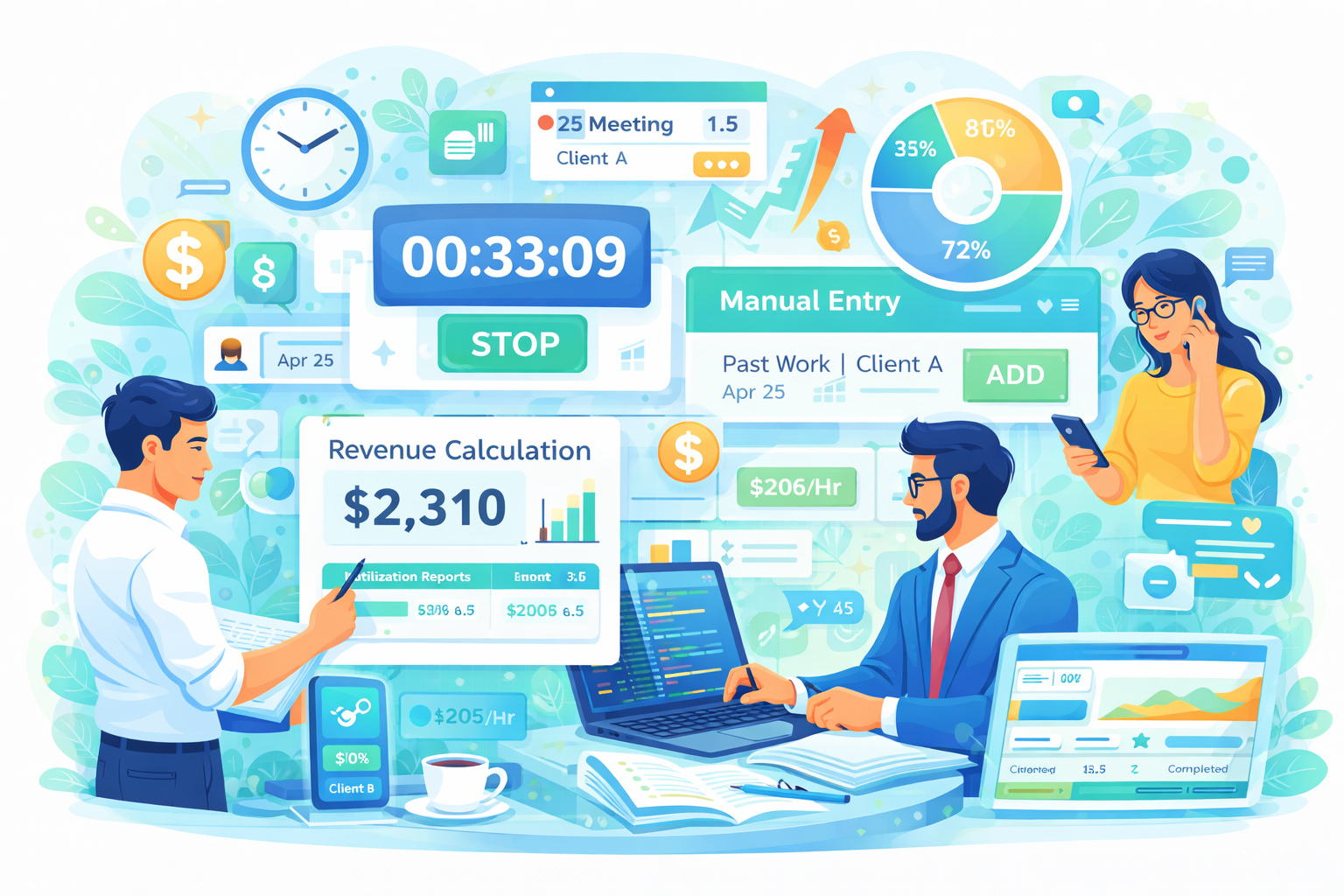
Track time down to the minute. Manual entries for meetings, automatic timers for focused work.
- Timer + Manual Entry - Use a timer or add time manually for past work.
- Revenue Calculation - See earnings based on your hourly rates.
- Utilization Reports - Track your billable ratio over time.
Client Engagement Management
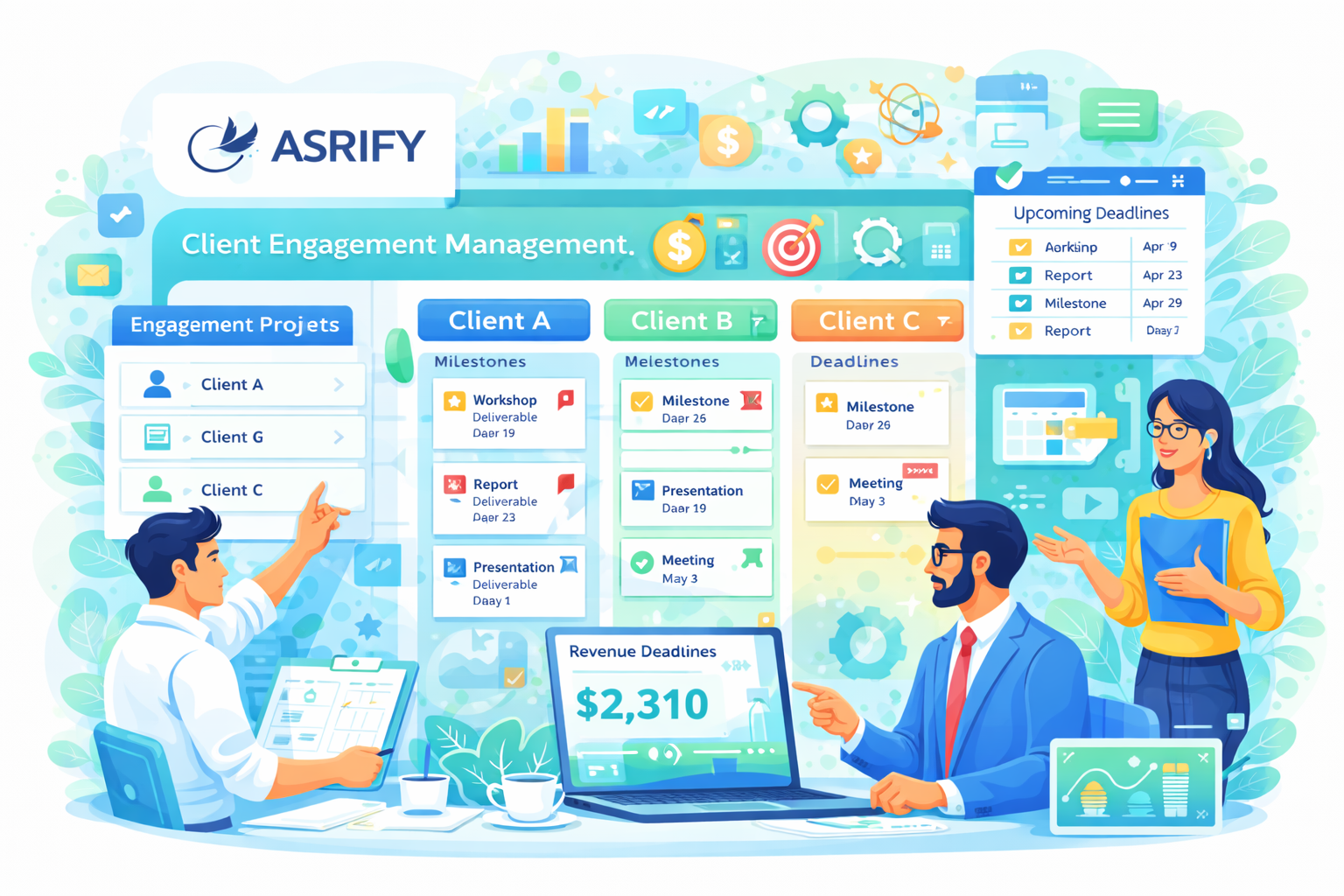
Organize each client engagement with deliverables, milestones, and deadlines.
- Engagement Projects - One project per client engagement.
- Milestone Tracking - Set milestones for key deliverables.
- Deadline Visibility - See all upcoming deadlines in one view.
The Consulting Business Reality
Consulting is fundamentally a leverage business. Consultants sell expertise accumulated over years, packaged into engagements that solve specific client problems. The economics only work when consultants can charge rates that reflect this expertise while maintaining high utilization. A consultant billing 70% of available hours at premium rates can build a sustainable practice; one billing 40% cannot, regardless of their hourly rate.
Client relationships in consulting follow predictable patterns. Initial engagements often start with discovery or assessment projects that establish credibility. Successful delivery leads to implementation work, ongoing advisory retainers, or referrals to other parts of the organization. Tracking which engagement types lead to follow-on work helps consultants focus their business development efforts.
The proposal process consumes significant unbillable time that many consultants underestimate. From initial conversations through scope definition, pricing, and negotiation, a typical consulting proposal represents 20-40 hours of work. Win rates vary widely by industry and relationship depth, making it essential to track proposal time separately and understand the true cost of sales.
Knowledge management determines whether a consulting practice scales or stays dependent on individual expertise. Every client engagement generates insights, frameworks, and deliverables that could accelerate future work. Consultants who systematically capture and organize this knowledge can onboard new team members faster and deliver consistent quality without reinventing approaches for each engagement.
I finally stopped guessing how many hours to bill. Asrify shows me exactly where my time went.