
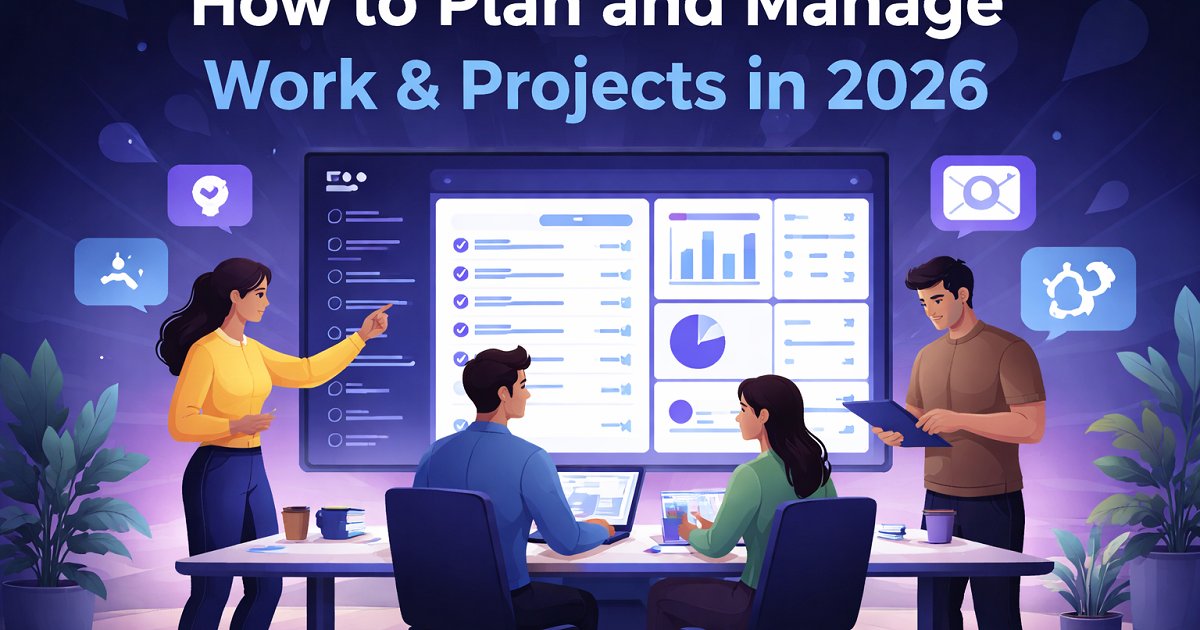
Work in 2026 looks very different than it did just a few years ago. Teams are more distributed, projects move faster, and expectations are higher than ever. Managing work is no longer about just “getting tasks done” - it’s about clarity, visibility, focus, and sustainability.
In this guide, we’ll break down how modern teams should plan and manage work and projects in 2026, what has changed, and what actually works.
1. Planning in 2026 Starts With Outcomes, Not Tasks
In the past, project planning usually began with long task lists. In 2026, successful teams flip this approach.
Instead of asking:
“What tasks do we need to do?”
They ask:
“What outcome are we trying to achieve?”
What this looks like in practice:
Define clear goals for every project
Attach tasks directly to outcomes
Measure progress based on results, not activity
This mindset prevents busywork and keeps teams aligned, especially when working remotely or asynchronously.
2. One System for Work, Not Five Different Tools
By 2026, teams are actively moving away from tool overload.
Using separate apps for:
creates friction, context switching, and lost data.
The modern approach:
Tasks, time, communication, and insights connected in one place
Real-time visibility for managers and team members
When everything lives together, planning becomes easier and execution becomes smoother.
3. Time Tracking Is About Insight, Not Surveillance
Time tracking in 2026 is no longer about monitoring people — it’s about understanding work.
High-performing teams use time data to:
Improve estimates
Balance workloads
Identify bottlenecks
Prevent burnout
Plan future projects more accurately
Best practices:
Track time per project and task
Review time weekly, not obsessively
Use insights to improve planning, not punish people
When teams trust the system, time tracking becomes a tool for growth, not pressure.
4. Projects Need Structure, but Flexibility Wins
Rigid project plans fail in fast-moving environments. In 2026, flexibility is built into planning from day one.
Modern project structure includes:
Clear phases and milestones
Short planning cycles
Space for iteration and change
Continuous feedback loops
Instead of locking everything upfront, teams plan just enough and adjust as they go.
5. Communication Must Be Contextual
One of the biggest productivity killers is scattered communication.
In 2026, effective teams:
Communicate inside the project
Keep discussions attached to tasks and decisions
Avoid long email chains and disconnected chats
This ensures:
No lost context
Faster onboarding
Clear ownership
Better decision-making
When communication lives where work happens, teams move faster with fewer misunderstandings.
6. KPIs Turn Planning Into Strategy
Planning without measurement is guesswork.
Modern teams define Key Performance Indicators (KPIs) for:
Project delivery
Team efficiency
Budget usage
Time vs. value produced
KPIs help teams:
See what’s working
Fix what’s not
Plan future projects with confidence
In 2026, planning and performance tracking are no longer separate — they’re deeply connected.
7. Sustainable Work Is the New Productivity
The biggest shift in 2026 is this:
productivity is no longer about doing more — it’s about doing better.
Smart planning protects:
Focus time
Team energy
Mental health
Long-term performance
Sustainable teams outperform overworked teams every time.
Final Thoughts
Planning and managing work in 2026 requires more than spreadsheets and task lists. It requires:
Clear outcomes
Connected tools
Meaningful insights
Flexible systems
Human-centered workflows
Teams that adapt to this new way of working don’t just finish projects — they build momentum.
If you’re looking for a simpler, more connected way to plan, manage, and track work in one place, platforms like Asrify are built specifically for how teams work today and beyond.


